Tuesday, 22 December 2009

Bank Aid - Do they loan this Christmas


Henry Travers as Clarence after "saving&q...Image via Wikipedia
What an upset then that Joe McElderry’s X Factor song didn’t get to the converted No1 position, but instead we end up with Rage Against the Machine and their offering Killing in the Name, thus ending Simon Cowell’s domination of the festive charts for the last five years. And what was the excuse served up for this failure then, arctic conditions kept the punters away.


Well never mind the excuses and the yarn spinning, the fact is music has taken a turn for the worst if it's not been on the slide for years. What’s not unique about our music these days says it all if this strumpet is offered up for our festive number one.

But having said that; there maybe some significance publically here, why did the public give support for this festive hit and to be quite honest, if you heard it on Christmas day whilst having a quickie down your local, that’s if you still have a local within a radius of say five miles, wouldn’t you feel like that guy in the film It’s A Wonderful staring James Stewart whose imminent suicide on Christmas Eve gains the attention of his guardian angel, Clarence Odbody (Henry Travers) who is sent to help him in his hour of need.

Jesting aside, was this vote holding or saying something more than just a rebellion against the Cowell control and packaging of a short-lived teenagers dream, we ‘knickknackery’ do wonder?

All of a sudden reality TV is the in thing then, a  forum is now being lined up for our top political leaders to exchange bows whilst all intending to do the same thing if elected. Just how many people will bother to tune in is another thing, or how many TV set's get flung out, what with the party political broadcasts, this may prove to be a very unpopular move especially when you think about the fiddlers all. Maybe someone should start a face book page that impacts on the outcome of the general election?

Staying with television even Her Majesty is having problems, a recent poll reported that only 12 per-cent of the public were looking forward to her Christmas Day speech. This is some drop when you think that 28 million watched it in 1987 and only eight million last year, so what’s that say?
Reblog this post [with Zemanta]

Wednesday, 16 December 2009

Bringing home the Bacon!


                        Richard Bacon MP   
                                          

It takes time for a blog to take off and be noticed; considering that the blogosphere simply has so many of them. A political current affairs blog, if anything, is even more challenging, but the authors and generators of ‘In the Box’ had no great expectations when we set up the site a few weeks ago, our goal and objective was to participate via the internet and cyberspace in debate raising it, and contributing into the public flow of things with the hope that some of our ideas may strike a cord with others.

So it came altogether as a complete surprise; that our post on homelessness ‘Down and out in Mayfair’ managed to stimulate a response from Tory MP Richard Bacon, but to be fare to Richard we did quote him in that post or rather used a quotation that was first published in the Daily Mail. It was what he said in his role as a then member of the committee on public spending in which he articulated that:

“The Department for Work and Pensions dose not know how many people are out of work by choice, rather than by chance. Properly targeted help must be put in place for those who want to work. Only then will the Government be able to flush out the shirkers who are sticking up two fingers at hard-working families and treating the benefit system like a cash machine.”

The problem with the above statement is that the Member of Parliament for South Norfolk offers not one shred of evidence to back-up his preposterous, ludicrous and very much incongruous slander on all unemployed working people. Then on the other hand when we look at MP’s expenses and in particular those made by Richard Bacon; we discover that this member was alleged to be the politician with the highest expenditure on taxi and car hire during the year 2006 a claim which he disputed and referred to the National Audit Office. However In May 2009, it was reported that Bacon used his Parliamentary expenses to claim £258 for two framed prints of Rome, £294.30 for nine cushions and £1,547.20 for curtains.


Well whatever the case may be, the fact is that MP’s have helped themselves to a large amount of lose change and by choice, in fact they had taken the chance and someone blew the whistle on them and not for a penny in a tin. Whatever happens after the next general election, one thing is for sure; the real fiddlers and shirkers who are sticking up two fingers at all working people unemployed of not, will still be trying to give us all lecturings and more besides, whilst helping themselves as they have always done.

In his communication with us Richard Bacon say’s that he had read the article through and then states:

“It is not the homeless who are “sticking up two fingers at hard-working families and treating the benefit system like a cash machine” and nor did I say that it was.”

Yes Richard we agree you did not say that; and we are not saying that you did. We were using your example of showing how you politicians are pushing about the housed unemployed, to demonstrate why many homeless and unemployed don’t claim benefit entailment.


Get It! It's in the box!


Reblog this post [with Zemanta]

'In the bleak mid winter'

Image via Wikipedia

Collage of various Christmas images, made from...Is it the ‘rain before the storm’ or the ‘snow before the avalanche’ is the question that’s floating around In the box this morning as we evaluate the latest unemployment fingers.

The number of unemployed in the UK increased by 21,000 over the last quarter to hit 2.49 million, the highest figure since the three months to March in 1995.

But this is the smallest quarterly increase in the number of unemployed people since March to May 2008.

The number of people unemployed for up to six months fell by 98,000 on the quarter to reach 1.31 million. The number of people unemployed for more than 12 months increased by 49,000 over the quarter to reach 620,000, the highest figure since the three months to November 1997.

The unemployment rate for 18 to 24 year olds increased by 0.9% points on the quarter to reach 18.4%, the highest figure since records for this series began in 1992.

So the claimant count for unemployment posted a surprise fall which Gordon Brown will receive like a gift from Santa in his pre-Christmas Grotto. The unemployment count in North Lincolnshire which includes Scunthorpe increased by 53 people, but in London unemployment has raised by 2,000, taking the total number of people out of work in the region to 377,000.

The jobless rate for the region is now 9.2%, which is the third-highest rate in the country, according to figures from the Office of National Statistics. While sterling took some comfort from the monthly figures, the majority of experts expect unemployment to keep rising next year. So while city dealers, the bankers and government look forward to their festive seasonal merriments; for many of the unemployed Christmas will be bleak!
Reblog this post [with Zemanta]

Sunday, 13 December 2009

Hark, the herald angels sing...


In the news recently I read that the Royal Bank of Scotland’s Board was threatening to resign over the whole scandal about bonuses’, that’s if they weren’t allowed to pay them out. I think of myself as average in many respects of my life, but of recent years I must say and in a crude way really , I’ve become more and more increasingly ‘pissed off’ with much of what’s going on around me, and for that matter around all of us! From the scandal of expenses for our parliamentarians to daft and stupid regulations such as the fine given to a young mother for allegedly littering; in fact her little boy was feeding the ducks.

In my head I cry out, are we all being wound up, someone tell me that this is all a joke. It may be my petty little whinge, but nevertheless it’s important, and worthy I think of consideration.

The young mother and child were recycling their wasted bread, feeding it to the ducks and in the process deriving much pleaser from sharing their waste; after all it was a much better idea than destiny landfill site.

Much of our waste ends up in the landfill-sites, and we waste a shit load; ‘that’s me being crude again’. But it’s no joking matter, just consider this: households discard 4.1 million tonnes of avoidable food waste, worth a staggering £10.2 billion every year. Much of the food that we throw away is unopened 1,600 million apples, 1,030 million tomatoes, 2,570 million bread slices, and 484 million unopened yoghurts.

Well might we say ‘let them eat cake’, while bread accounts for 505,000 tonnes of avoidable household food waste, cakes and puddings (I do like a good pudding) puts in a reasonable showing, at 86,000 tonnes per year. The simple fact is we in the UK tip into the ground 27 million tonnes of waste each and every year – 7 million tonnes more than any other European country, and when you consider the decomposition of the waste its impact on the environment I then ask why was that young mum given a fine?

Back to the bankers (Wankers) Christmas bonus, this is no incentive, helping themselves to a share of the money, money and profit made from the so-called government cash injection known as quantitative easing, an extreme form of monetary policy used to stimulate an economy where interest rates are either at, or close to, zero. Normally, a central bank stimulates the economy indirectly by lowering interest rates but when it cannot lower them any further it can attempt to feed the financial system with new money through quantitative easing. That’s when governments and central banks responded with unprecedented fiscal stimulus, monetary policy expansion, and institutional bailouts and here in Britain trillions were poured like it rained cats and dogs and, into the banking system. And then this time last year it started to emerge that bankers were earning vast amounts of money, whilst at the same time bringing about the worst rescission in living memory. They and no-one else are responsible for the misery and ill-being due to the affliction that has left millions around the world without homes or jobs stagnating in poverty.

What’s the fuss, I hear someone say?


They create pain hurt and misery; and then they want paying for it, one example comes to mind: it was earlier this year that I read of a banker who Two Methuselah of Don Perignon champagne at £9,000 each, four Jeroboam of Crystal champagne costing only £4,500 each. For those of us that don't know, a Methuselah is eight times the size, of a normal bottle, and a Jeroboam is four times the size of a normal bottle of bubbly. Interesting or what, well that's what some people spend on drink believe it or not. It's what this banker spent earlier this year whilst out on the town with his mates; in fact he spent in total £43,064.50 in the Maya nightclub which is in London's Soho.

Now we can begin to get some idea, why bankers need bonuses of millions, of course, how stupid, they have outgoings and costs just like us all, but would we spend that obscene amount of wedge on an evening’s fun. Most of us don't even earn that amount of money over a two to three year period of time, and yet these bankers who are back in the news spend money like it was confetti thrown around on festive occasions.

Who are these bankers then that command such remuneration for their services to the banking industry, apparently there is only 5000 of them, is that a blessing and - I don't wonder.

So 5000 city gold plated bankers may earn over £1 million while city traders rack up an estimated £5 billion just 12 months after the near-collapse of the entire financing system that they caused in the first place and that this government rescued them from.

Just give them all a sword to fall on!

The higher up the social scale you are or the more money you can rip off from the system; The bigger the Barrister the more interrogate the laws are to let them keep it or even award them more, lets just keep taking the tablets.

Years ago when I was a young man of 18 I was in the Royal Engineers and I had to travel the London underground on my way home, Up North as you might say; with my week-end pass in my pocket, I was so surprised to see all those thousands off people rushing about, all in a little world of there own, you could see just by watching them they had trekked the same course day after day after day, And how did they all squeeze into those little boxes, After I found out how and watching in amazement, Lots off things ran through my mind almost at the same time. and with mixed emotions. These are the workers in our Capital city that go about their business every day , each in their own little way, like soldier and worker ants, each doing their little bit to keep everything working. I was proud of them and sorry at the same time, but it’s they not the bankers – but the steelworker, the bus and train driver who create all wealth only to be ripped off.
Reblog this post [with Zemanta]

Wednesday, 9 December 2009

Child poverty on the up!

Child poverty is soaring despite Government promises to wipe it out.Four million children are now living in poverty, Barnardo's says, with their parents having £10 or less a day to pay for food, heating, clothes and electricity for each family member.

Child poverty rose in 17 of the 20 poorest constituencies in Britain last year.Ladywood area of Birmingham had the highest concentration of youngsters living in poverty, 83 per cent, which was up 2.5 per cent in a year. This was followed by central Manchester with 81 per cent, and Sparkbrook and Small Heath in Birmingham with 80.4 per cent.

Barnardo's chief executive Martin Narey warned things will get worse as the recession continues to bite. He said: "It is intolerable that in some places in the UK eight out of 10 children are growing up poor."


Reblog this post [with Zemanta]

Saturday, 5 December 2009

Climate Justice?


More than 50,000 people came together to demand action on climate change today at The Wave, the biggest ever UK climate change March. The Wave and called for the Government to take much more urgent and effective action.


Well went to the London demonstration ‘The Wave’ and I suppose that sounds like the name for a ride at one of those adventure theme parks. The organisers are claiming 50,000 and the police as usual are saying half as many, funny how the police always do this and when you consider that the organisers included church goers, inclined to make you wonder whose exaggerating?

The church was well represented as I lost count of the number of dog collars, so many reminding me of the Vicar of Dibley and its wonderful lead actress, Dawn French. But it was a wide diverse mixture that came out to protest ahead of the Copenhagen climate Conference next week.

Strange to think of vicars, priests and clergymen; that’s men of the cloth, and now all 'Domestic Extremists'.

Had an interesting conversation with one lady who came up to me and said that we all had better change our ways! That we all as consumers, were doing loads of damage to the environment, she was saying something similar to what was on many placards’ that people were carrying; ‘Our Climate is in Our Hands’. My line of argument with the lady was that at this moment of time, the fate of the planet is very much out of our hands. That we cannot expect any effective action to address climate change on a world level because capitalism based on and controlled by profit making, supported by world governments who have if nothing else demonstrated with their support of the world banking system, that they will put profits and, the continuation of that system before anything else. That’s why climate change is very much out of our hands. Global warming and climate change is taking place under the system of capitalism and most scientists in effect say that it’s this very system of organisation for profit that’s harming the planet.
Reblog this post [with Zemanta]

Thursday, 3 December 2009

Mayfair? Not fair!


We still live in a society that if you don’t have the ability to pay you ‘goes’ without.


Paying fuel bills can be hard at the best of times but you are twice as likely to fall into fuel poverty if you’ve recently been treated for cancer, according to new research from Macmillan Cancer Support. Following diagnosis, three-quarters of cancer patients in active treatment need to use their heating more, yet those under 60 do not qualify for any help to pay for it. Fuel poverty – having to spend more than 10 percent of your income on heating – is a relatively new phenomenon that is beginning to grip Britain faster than the spread of swine flu and serves as the cold reminder that we still live in a society that if you don’t have the ability to pay you go without.

The true extent of such hardship and poverty in Britain and its impact is conveniently bypassed and generally ignored by mainstream politicians who have more to peevishly whinge about when it comes to their own expenses. As we come to almost the end of this the first decade of the 21st centaury it’s as if the hands on the clock of time have been turned backwards. If it wasn’t for the constant sight of all manner of technology’s advancement from transport to the smallest iPods, cyberspace and the internet you would not be wrong to conclude that some things change but much, very much just stays the same, as I’m constantly reminded when I visit and spend time with my many friends who live their lives out and on the streets of London, the capital city in this the fifth richest nation in the world.

Homeless

The people that I speak of are the visible homeless that no one seems to see. Their numbers are hard to place a finger on, they live in hostels, squats and a growing number sleep rough on our streets. Keeping warm in winter is a battle waged every year by the rough sleeper in his or her skip, but truth is every season brings its problems when you’re forced to share the outdoor life with the birds, urban foxes and city rats.

A great many of my friends on the street live and rely solely upon street handouts and day centres for food, laundry and bathing facilities. Many refuse to claim entitled benefits, preferring not to be a part of a welfare system that incessantly strong-arms the unemployed into taking low paid employment with the use of sanctions and penalties. This is in complete contrast to what Richard Bacon, a Tory MP on the committee which acts as a watchdog over public spending, said:

"The Department for Work and Pensions does not know how many people are out of work by choice, rather than by chance. Properly targeted help must be put in place for those who want to work. Only then will the Government be able to flush out the shirkers who are sticking up two fingers at hard-working families and treating the benefit system like a cash machine."(Daily Mail)

How can anyone not be moved by the spectacle and lines of men and women who gather every night in London’s Lincoln Inn Felids for a meal provided by the Hari Khrisnas or a Jamaican Christian Church. On some occasions I’ve counted up to three hundred people who arrive hours in advance with all their worldly pocessions rammed in to rucksacks and carrier bags, sleeping bags and their wind-up radio. This is no easy life. The streets are fraught with danger for many homeless people; over the last few years people living on the streets have become more vulnerable to violence and attack; this threat can be from other street users and from those who are intoxicated through alcohol and/or drugs.

Rough sleepers are 13 times more likely to experience crime and 47 times likely to be the victim of theft. Crime, and the perception of crime, can play a major role in the decisions of rough sleepers in not only where they sleep but also where they take part in daytime activities. Many rough sleepers avoid danger and stay clear of violence by using the London night bus service to get some rest, as one friend told me: “You take the longest route say to Heathrow Airport and back that kills 4 hours and before you know it it’s morning.” Female rough sleepers are particularly vulnerable to physical attack and abuse, and to protect themselves they tend to be amongst the most hidden.

Rough sleepers are met with a mixture of emotions from the general public ranging from pity and support to anger and distrust. But one thing almost goes unasked and that’s why are people, fellow human beings living, existing on our rich streets; streets that are not paved with gold.

London has seen a big increase in the number of migrant workers left homeless and destitute in the city, without access to benefits or housing help. The effects of the economic downturn, as well as a legal block preventing migrants from certain countries claiming benefits, has meant increased numbers of rough sleepers in the city from eastern European countries.

Every year an official head count of rough sleepers within Westminster is carried out and recorded for official purposesî In recent years allegations of tactics designed to reduce the figure have been made. The Simon Community, an organisation that works and lives with the homeless on the streets, undertook its own street head count at the end of October, and found 247 people sleeping rough in the City of Westminster, almost 100 more than official figures now state. The Simon Community along with some rough sleepers have claimed that diversionary tactics were put in place days before the street count took place. A number of known rough sleepers were offered travel warrants by Police and community officers, in an attempt to transfer them out of the area. In a BBC report on the issue of travel warrants being handed out, the Metropolitan Police denied the allegation that they were shifting people out of the area, saying that they regularly issue travel warrants for homeless people, particularly during the winter months. Allegations have also been made that local authorities exerted harsh measures against homeless people, according to the Simon Community. They received information about a group of homeless people being physically moved out of the Victoria Street area by Police. Similarly, there are accusations of doorways used to bed down in were hosed by cleaners to make them unusable.

There are claims that charities were also instructed to make beds available in their hostels ahead of the count, and emergency accommodation was opened up on the week the count took place.

Reality entertainment

During the summer the BBC screened a very different type of reality television; this involved celebrities who were asked to partake in the programme ‘Famous, Rich & Homeless’. This TV documentary, described as thought-provoking, recruited five famous volunteers who were asked to experience the life of a homeless person on the streets of London for a few days (ten) during the winter of 2008. When I say famous, what I mean by that is household names drawn from the entertainment and media industry. The Marquess of Blandford, the One Show’s Hardeep Singh Kholi, journalist Rosie Boycott, former Coronation Street actor Bruce Jones and tennis commentator Annabel Croft all swapped their lavish privileged lifestyles, their fame and fortune for a time; for a world of soup runs and hostels.

They were helped and manoeuvred throughout by Big Issue founder John A Bird and Craig Last, a former youth worker for the charity Centrepoint. Having watched the show myself; I came away thinking that this type of reality entertainment achieves nothing more than accepting and approving that the daily struggle for life’s existence at the bottom of the pile is a normal part of the structure of society. But the best response to the show came from a homeless person writing in the letters page of Pavement the free monthly magazine produced for London's homeless; they said:

“I found it quite ironic that ‘Famous, Rich and Homeless’ was shown on the BBC. I spent seven months living rough on London's streets, often at All Souls' Church in Portland Place. Having crashed there for several months, rough sleeping with the full knowledge and permission of the church authorities, I was woken one night and "moved on" by a couple of Westminster police officers. When I enquired about the incident at the church reception the following morning, I was informed by a staffer that the alleged complaint had not been lodged by the church authorities but by BBC security staff at Broadcasting House, directly across the road, no doubt because they were irritated by having to constantly step over cardboard boxes whilst filming fearless, hard-hitting documentaries about the plight of London's homeless.”

About the same time as these programmes were broadcast, The Wall Street Journal (15 July) reported; that in the London Borough of Westminster, where Mayfair is located, homes can cost up to £50 million. Yet Westminster is fifth among London's 33 boroughs in the number of unoccupied properties. In 2008, 1,737 homes had been vacant for six months or more, the third highest number among all London boroughs, according to the Empty Homes Agency, a non-profit group that seeks to put empty homes back into use.

Westminster Council have placed according to its website (at the time of writing) 3.000 homeless families into temporary accommodation. Many have been exported to the poorer boroughs of East London because they claim there are not enough temporary in Westminster.

The high concentration of rundown, empty homes is striking for a posh Mayfair, with its ornately gated manses. The hub of aristocratic society before World War II, Mayfair's modern-day image is demonstrated by its prominent place on the British Monopoly board.

Mayfair's homeowners aren't down on their luck, far from it. Rather, there properties serve as investments for owners who pay the bills to keep them empty – something the neighbours and council object to when the homes fall into disrepair. Many owners decline to rent the homes due to local council tax rules, with tax on properties at a lower rate if they are empty and unfurnished, which is a loophole that helps the filthy rich. As the number of homes now priced at more than £1m has fallen by a third during the past two years the problems surrounding the abandonment of posh homes may get worse.

The whole business of empty homes came to light last winter when a group of young squatters occupied two £20 million homes on Park Lane overlooking Hyde Park. Before the squatters settled in, the homes had been empty for seven years. During that time, the Council had tried three times to contact their British Virgin Islands-based property owners: Red Line Ltd. and Perfectil Ltd. Following two years of silence, the property owners surfaced once newspaper reports outed the squatters. The result of such media reports has meant that wealthy homeowners have turned to private security firms to protect their empty London properties from squatters at a cost of up £2,600 a week while according to the Empty Homes Agency there are more than 80,000 empty properties in London (Evening Standard, 11 November). In the recession this is one business that may prove to be very lucrative as a growing number of homes are bought by foreign investors who want a secure asset but continue to live elsewhere.

In our daily press we read much about the housing problem, about lost homes repossessed by the banks and the so-called housing shortage, with thousands stranded and languishing for years on the council housing waiting list or simply held hostage to the private landlord, the cry goes out for more affordable homes or a proposed programme of public works that embraces house building as the desired solution, peddled by those who still offer the dried-out old fig leaf of failed reform. Over a hundred years ago Frederick Engels wrote in the Housing Question: “This shortage is not something peculiar to the present; it is not even one of the sufferings peculiar to the modern proletariat in contradistinction to all earlier oppressed classes. On the contrary, all oppressed classes in all periods suffered more or less uniformly from it.”

And then Engels gave an answer to this age old problem. He said, and I repeat, to end the housing shortage there is only one means: to abolish altogether the exploitation and oppression of the working class by the ruling class.

NL

Also published in the December issue of the Socialist Standard


Reblog this post [with Zemanta]

Labour election hopeful removed - Off with his Head!


In the Box has learnt from a source at the BBC; that a Labour election hopeful who called the Queen "vermin" has been removed from the party's list of candidates.

Would-be local councillor Peter White was axed by party bosses after being forced to apologise for an online rant about the monarch's diamond jubilee.

Mr White, who had been due to fight for a seat on Havering Borough Council next year, also described the Queen a "parasite" in a post on Facebook.

He appeared before a regional Labour Party panel earlier.

His comments were posted on the Facebook page of Tory MP Andrew Rosindell, who is campaigning for the royal milestone to be marked with a public holiday.

Mr White posted: "What is the point of celebrating the diamond jubilee of someone who is born into a position of privilege, she is a parasite and milks this country for everything she can."

He went on: "Don't get me wrong, I have no problem with a public holiday but lets (sic) have one that means something, rather than celebrating vermin.


A Buckingham Palace spokesperson declined to comment to In the Box.


Reblog this post [with Zemanta]

Wednesday, 2 December 2009

Things Can Only Get Better?

Fuhrer Tony BlairImage by acidrabbi via Flickr


Brain Hopper was the Socialist Labour Party candidate for the Town of Scunthorpe in the 1997 General Election and stood against Elliot Morley. In the Box asked him for this thoughts looking back to that time.


After John Smith died and Tony Blair came to the forefront of the Labour Party, I just could not understand; what was happening, and the more I saw the more I did not like.

How did this man get to become the leader off the labour party? This person to me sounded like a Tory, he even looked and walked like a Tory, not that I had ever realised before how a person looked or walked or even recognised the ‘walk likes’ of a Tory, I must have it all wrong, we had just had the ‘Iron Lady’ and then John (Curry) Major. We had big names at the top, where did this Tony Blair fit in, all our union representatives and the people at the top; they know what they are doing, I must be totally wrong about this man, but after they removed ‘clause four part four’ from the constitution of the Labour Party my concerns were confirmed.

Many things happened in my life in such a short time and I happened to meet a man who thought and felt the same as me, but compared to me he really new his politics, his name was Jim Lawrie and together we joined the Socialist Labour Party and we stood against New Labour, May 1997. As we all know the country got Tony Blair as Prime Minister and we in Scunthorpe got Elliot Morley. I would have been happy if UKIP or the Referendum Party had won at the time, we may not have been robed as much? However the country had democratically selected through that election a new Prime Minister and, we had New Labour and a new political touchstone at the closing years of the century and the start of the new millennium.

What could be better than this; I have done my bit and but up the fight – After all: “Things Can Only Get Better?”

A decade has gone by and what do you want me to say, what can I say? I wish I could say everything you would like to hear, but the truth is I can’t, just look and learn!

We all had the playground scenario with Tony and Gordon, Tony said to Gordon you go in goal until half time then you can be captain, But half time came and Tony said you're doing such a good job in goal stay there a bit longer, at the end of the game Gordon spat his dummy out and, had a go at Tony, to witch Tony replied you can be captain next time.

Time went by and still Gordon was not happy with Tony, but Tony had found a new friend who was the captain of a much bigger team, his name was George, Tony kept popping over to see George and they became really close, then one day George told Tony he was having real problems with an ‘arse hole’ who just would not do as he was told and that his father has had problems with the same person in the passed, So George,Duke Wayne the cowboy that he thinks he is, With his two guns strapped on and ready to draw on anybody, asks Tony if he wants to be his deputy, Tony who has always wanted to be a cowboy said yes and together they decided to send their boys in to sort this ‘arse’ out, and all off his mates.

After ten's of thousands of collateral damage: Murdered Civilians: and the illegal war still going on today, Tony Blair the snake in the grass that he is, looked at this situation he and his one time mate had created and now decides; he know longer wants to be a cowboy, realising trouble is coming his way, He finally say's to Gordon, you can be captain now, and off he went making millions on the way, as reported in today's 'Guardian:Blair is estimated to be in the process of receiving up to £14m, making him one of Britain's wealthiest ex-prime ministers. This includes a £4.6m memoirs deal with Random House.

He is also receiving a series of US fees from the Washington Speakers Bureau for making speeches estimated to include a £600,000 signing-on fee; consultancies with the US bank, JP Morgan and with Swiss insurers Zurich Financial Services; and commercial consultancy deals through his private firm, Tony Blair Associates, with regimes in Kuwait and the United Arab Emirates among others.

The growth in Blair's personal wealth was illustrated in May 2008, when he agreed to pay £5.75m for the late actor John Gielgud's Buckinghamshire residence, described as "a small stately home".

This was in addition to the £4.45m paid earlier for a London home in Connaught Square, together with an adjoining mews house.


He has gone to try to make trouble with another team, set up his own faith foundation, joined the Roman Catholic Church. They can have him; after all there not that smart. As the saying goes; ‘you can take a camel to the water, but you can’t make him drink it’

GOOD RIDDANCE!


Reblog this post [with Zemanta]

Tomlinson Vigil


On a rather cold central London evening a moving vigil was held to remember the life of Ian Tomlinson the newspaper vendor killed by the police whilst walking home from work during the G20 demonstrations last April.

The vigil was called by the Tomlinson family to mark the eight months; since Ian’s death and was held at the back of the Royal Exchange and near the place were he died.

Over a hundred people gathered and demonstrated their support and solidarity with the Tomlinson family, whose pain and loss of a much loved dad and husband were visibly clear for all to see. With the family event of Christmas almost on us, I would like to think that that such a gathering helps somehow to ease the burden of pain; at their very real literal loss.

The family arriving together were all emotionally, but bravely dealing with that pain, eyes understandably tearing up as they took there place at the front of the vigil. Ian and his wife had nine children in all together, who I could only describe as a credit to both parents, and these young adults immaculately turned out solidified iron like; the strength of Ian’s widow Julia.

I should also say that the vigil had a representative of the Jean Charles de Menezes family who spoke words of support, she was joined by others they included MP John Macdonald, family solicitor Jules Carey and the family of Sean Rigg, 40, who died in custody at Brixton police station in August last year.
John Macdonald apologised to those who had difficulty in hearing the contributions’, this was due to the fact that the Royal Exchange had withdrawn permission to use a small specking system.

Julia Tomlinson said that the family would never give up until they had answers about the death of her late husband. "We will not give up until we get it." She said it had been "a long and emotional time for us all as a family" and as they prepared for their first Christmas without Ian.

The one other thing to mention here is that London Mayor Johnston the Boris sent a message that was read out it said: "As Mayor of London, I'm sure I speak for all fellow Londoners when I send my sincere condolences to the friends and family of Ian Tomlinson.

Christmas is a time for families but for members of the Tomlinson family this will be a very difficult Christmas without their loved one.

Our thoughts are with them."

In conclusion, the state of play is this; the Tomlinson family have lodged a fresh complaint with the Independent Police Complaints Commission, claiming a senior Metropolitan Police officer misled those investigating his death as part of a "cover-up". Meanwhile a member of the Met's territorial support group has been suspended and questioned on suspicion of manslaughter over Mr Tomlinson's death.

He was caught by an amateur cameraman apparently hitting Mr Tomlinson with a baton and pushing him to the ground.

A file was passed to the Crown Prosecution Service at the beginning of August by the IPCC.


Reblog this post [with Zemanta]


Photography By HarpyMarx:

(1) The Tomlinson Family at last nights vigil
(2) Julia Tomlinson
(3) John Macdonald

Tuesday, 1 December 2009


On Saturday 5 December 2009, ahead of the crucial UN climate summit in Copenhagen, tens of thousands of people from all walks of life will march through the streets of London to demonstrate their support for a safe climate future for all.

Part of a global series of public actions, The Wave will call on world leaders to take urgent action to secure a fair international deal to stop global warming exceeding the danger threshold of 2 degrees C.

The Wave - which is not just a huge march but a whole day of exciting campaign activities - is organised by the Stop Climate Chaos Coalition, will show mass support by people from all backgrounds for a better, low carbon future for the UK and the world.

We want the UK Government to show leadership at Copenhagen. We want them to Protect the Poorest, Act Fair & Fast, and to Quit Dirty Coal now, to inspire the deal the world needs..

Join The Wave - the UK’s biggest ever demonstration in support of action on climate change.

Please also add The Wave as an event to your Facebook and Twitter accounts.


Reblog this post [with Zemanta]

Copenhagen


The UN Cop15 Climate Conference is due to take place in Copenhagen from 7th-14th December. Billed as the last chance to save our future! Climate campaigners’ around the world are planning peaceful demonstrations, direct action and alternative forums to highlight the increasing concerns of many in regard to world climate change. In London an event named the wave has been organised for the 5 Dec with thousands expected to attend and participate, but more about that latter.

Hardly a week passes, without some media coverage or headlines about the environment and our changing climate, emissions, CO2s and pollution have become regulars in print. A widespread fear is voiced by scientists, environmentalists, and more recently even the politicians have joined in.

We are told that sea levels are a rising; rain forests are disappearing and deserts expanding, that the planet is heating up. Polar ice is melting and the ice sheets have revealed an extensive network of rapidly thinning glaciers that is driving ice loss in the regions. While the International Panel on Climate Change 2001 report predicted that the North polar ice cap would last to 2100 in spite of global warming caused by climate change, the dramatic reduction in the size of the ice cap during the northern summer of 2007 has led some scientists to estimate that there will be no ice at the North Pole by 2030 with devastating effects on the environment.

Our planet Earth has been described as a mere sphere of rock covered, in most places, with the merest smear of water and, outside that, by a slightly thicker layer of gas, our oceans and atmosphere, that contain and sustain everything that lives.

All life depends on the air and the water, in the sense that we could not live in an airless world or a completely dry one. We, by which I mean all living beings, the human race, the dominant spices, depend on air and water as the very requirement essential to our continuation. It is our responsibility to manage this life sustaining planetary environment, for we are only temporary its custodians, passing on from one generation to the next. The problem that needs addressing is levering, jimmying away the hands of those who care not for the future wellbeing of life and planet resources; whilst in the pursuit of markets and profits, a way of life that endangers life!


On Saturday 5 December there will be a march and demonstration in London to protest against not much being done about the threat of climate change.The marchers are gathering in Grosvenor Square at 12pm to set off to march toParliament Square at 1pm. They hope to encircle Parliament at 3pm but are morelikely to be themselves encircled by the police, even though there will be manychurch-goers and their pastors present.


Reblog this post [with Zemanta]

'Plug Plot Riots'

Perseverance Mill


In August 1842, Perseverance Mill was the scene for a Plug Riot. The 'Plug Plot' Riots refer to a couple of days in August 1842 when thousands of workers and Chartists, intent on pulling out the drain plugs of recently installed boilers in the mills, were met by troops of Hussars, Lancers and Infantry. The inevitable result was a series of clashes in the area, with people killed on both sides and the Riot Act being read out. Skirmishes occurred at Skircoat Moor, Perseverance Mill in Brighouse, the bottom of Salterhebble Hill, and North Bridge in Halifax. Those arrested were tried at York Assizes.

The building has been renovated and is now called Prego, a restraunt and hotel.


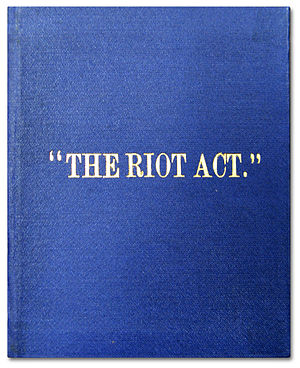
The cover of the British law The Riot Act from...

Image via Wikipedia


IN THE SUMMER of 1842 a low point was marked by a trade depression that gripped industrial England.

This lasted for nearly a year with, short-time working, wage reductions and escalating food prices were leading to boiling unrest. Times were so bad that, in Manchester, £2,800 that had been raised by subscription to buy a gift to mark the birth of the Prince of Wales was diverted to buy blankets distributed by ticket to 6,500 of the neediest townspeople.

On October 7th, 1841, the city despatched a cartload of petitions to Queen Victoria, begging her not to prorogue (hold back elections) Parliament "till the distress of the people was taken into consideration," while four months later the Quakers opened a huge soup kitchen in Bale Street, Manchester to feed the starving.

By August, discontent in Lancashire and Cheshire textile towns had reached exploding point. It needed one spark to ignite it and that spark came on Tuesday, August 9th, when the spinners at Bayley's Mill in Stalybridge were told their wages were to be cut.

They came out on strike, and were quickly followed by thousands more. Weavers, miners, labourers from Ashton and neighbouring towns descended on other Stalybridge mills demanding that work stopped.

And to ensure compliance, the strikers removed the plugs from the steam engine boilers, rendering the engines useless. So the rolling strike became known as the"Plug Plot."

Thousands of angry men marched from Stalybridge and Ashton to Manchester, calling out millworkers as they went. At dawn the following morning, a mass meeting of workers was held on Granby Row Fields in Manchester, and afterwards they marched through the city, ignoring magistrates who read the Riot Act at the Town Hall and moving on to Blackfriars Bridge over the Irwell, where they forced the gate and moved into Salford.

The strikers were generally peaceful but where manufacturers tried to impede their actions, there were clashes with police and troops. By Wednesday evening, virtually all Manchester and Salford were at a standstill and within a day or so, the strike had spread to many neighbouring towns.

Stockport, Hyde, Rochdale, Bury and Bolton succumbed, even Preston in the North and Stoke in the South were affected by what had been nicknamed the "Plug Dragoons." Yet despite their success and their parlous plight, strikers resisted the temptation to loot, as a contempory report in the Manchester Guardian illustrates.

Two boys stepped out of a striking crowd in Broughton Road, Salford, and went into James Faulkner's provision shop to ask for bread. He handed them a 4lb loaf which was "instantly torn to pieces by the crowd."

"There seemed at first an inclination among some of the younger portion of the crowd to enter the shop and see if they could not get some more bread, but the main body of the rioters forced them away, exclaiming that it would ruin their cause should they begin to plunder."

The strike had spread like a forest fire and had taken the authorities almost completely unawares. So much so, in fact, that some thought it was the beginning of something far more ominous.

Rochdale businessman John Bright for instance, writing to a relative, asked: "Has the revolution commenced? It looks very probable. The authorities are powerless."

His alarm was shared by the Government who, as it happened, were not powerless. For the first time, they used the railways to move 2,000 troops and six artillery pieces into Manchester and Salford. Railway workers did nothing - their jobs were new and they had not yet organised into unions.

Control of the strike was taken over by two trades conferences, the metal workers meeting at Carpenters' Hall and the rest at the Sherwood Inn in Tibb Street, Manchester, but the following week they joined forces and shifted their headquarters to the Hall of Science in Campfield, Manchester.

Encouraged by their early success, the strikers broadened their pay demands to include acceptance of the Charter. However, it was the original cause of the strike that contained the seeds of its failure. It had been an unconsidered, spur-of-the-moment affair and little or no planning had gone into it.

Had they paused to think, the strikers would have realised that, by withdrawing their labour, they were playing into the hands of the employers, many of whom were happy to close their doors and avoid paying wages at a time when trade was so depressed.

By August 20th, overcome by hunger, and with many of their leaders under arrest, the strikers were forced to slink back to work without having gained a single concession from their employers.

But at least some good came out of it, if only for a few. For instance Ben Brierley, later to become renowned as a dialect poet, noted with some satisfaction that demand for the velvet he wove had increased substantially because of strike shortages.